Showing posts with label frenchisms. Show all posts

Thursday, August 26, 2010

"Merde!"

As I left work yesterday, my last day of work before my Master's exam, I was treated to a heartfelt cries of "merde!" by all of my co-workers. When it comes to luck, the French are as superstitious as theater people, so the only words of encouragement they permit themselves is this (rather vulgar but amusing) variation on the "break a leg" idea. (My supervisor, however, followed her exclamation with a look of fear--"you do know that we say that right? Ok, good. I just realized how confusing that could be to a foreigner...") So in the spirit of Merde...

During my reviewing this month, I have permitted myself brief pilgrimages to the burial sites/monuments of some of the writers whose work I admire. I saved the photos for now, to offer as a last-minute tribute to their ghosts, who I hope will provide me with inspiration (not to mention hand endurance and cramp resistance!) in my furious writings tomorrow.

In the Latin Quarter's Saint-Etienne du Mont church, in the shadow of the Pantheon, I found Racine:
And Pascal:
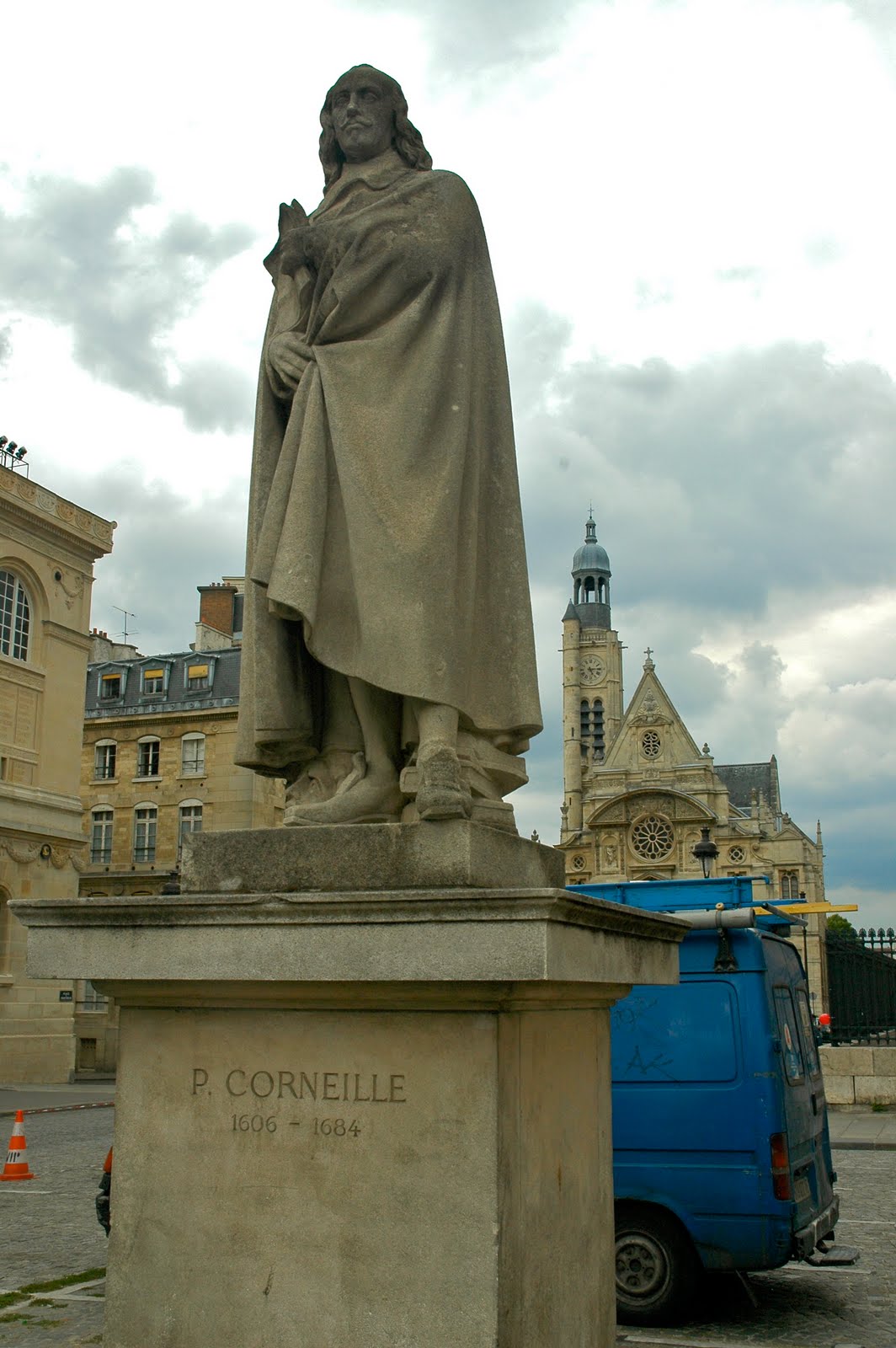
And outside the same church, their compatriot Corneille:
Diderot, beneath the Pantheon's dome:
In the Pantheon's catacombs, Victor Hugo and Alexander Dumas on the left, and Emile Zola on the right:
Also in the catacombs: Rousseau...
...and Voltaire:
The entrance to the Pantheon's catacombs bears an inscription in honor of the "writers who died for France"
Flaubert, in his family vacation spot of Trouville:
Moving on now to the Montparnasse cemetary, the shared grave of kindred spirits and love and philosophy, Sartre and De Beauvoir:
Close up of their grave, bearing Oscar Wilde-like kisses:
And of the metro ticket and centime tributes left by visitors:
Marguerite Duras:
Baudelaire (who, unfortunately, was forced to share a tomb with a stepfather he hated):
Beaudelaire's tributes:
My favorite absurdist, Eugene Ionesco:
And his anglophone contemporary, Beckett:
And, last but not least, Guy de Maupassant...
...and a hand-written note of appreciation, shoved into a crevice in the stone:

Saturday, August 21, 2010

à la plage

In spite of my busy studying schedule, we decided last minute not to entirely forgo a vacation and spent a weekend in Trouville and Deauville, two sister beach towns on France's northern Côte Fleurie:
I loved Normandy's beach culture. It had this really humble, authentically French feeling. It was much less trashy than Nice became in the height of tourist season, and sophisticated in a less ritzy way than the smaller Côte d'Azur towns. This is Trouville's equivalent of a boardwalk--consisting of playgrounds and pony rides for children, gelatto and cocktails for their parents, and a plethora of cute sea-side cafés that were surprisingly cheap given their location. We went to a salad place for lunch (smoked samon for me; roquefort, ladons and norman apples for the boy) just to the right of where I took this photo.

Trouville is also where Flaubert (the author of Madame Bovary) used to take his holidays, so there were various tributes to him scattered around the town. The swan on the side of the hotel in this picture is actually bearing a sleeping Flaubert on its back--it's the "Hôtel Flaubert".
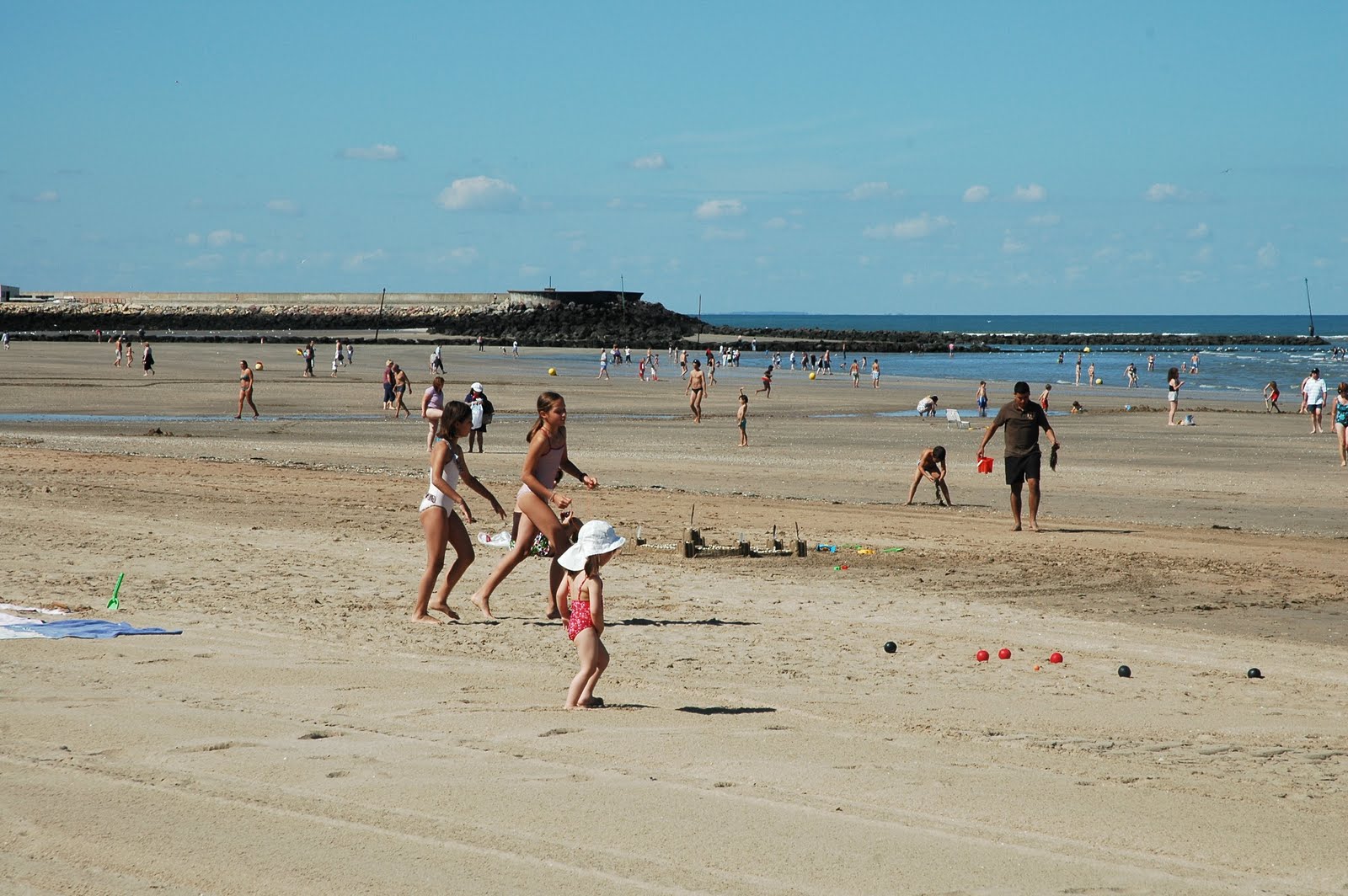
I was in love with this little girl and her huge floppy white hat. Here, she and her sisters are demonstrating one of the favorite French pastimes: pétanque (a ball-rolling lawn game, kind of like bocce ball). The beach had a special roped-off pétanque area (it's ideally played on dirt/sand that is packed down really firmly) and sets of the heavy metal balls to loan, but many families brought their own, plastic, beach-friendly versions.
Trouville town hall:
Trouville patisserie/chocolaterie. The decorative anchors and flower balls were the keystones of the town's picturesque landscaping efforts.
We managed to score a lovely hotel room with a last-minute discount.
The room even came with a sunny balcony, overlooking the center of town:
View of the pub, from the balcony:
And the night view, looking towards the strip of seafood restaurants. The restaurants' menus were virtually identical, but the hoards of French families on holiday didn't seem to mind. In fact, they seemed almost to expect it as a vacation rite: a bottle of white wine chilling in an ice bucket, an appetizer of terrine or smoked meats, an overflowing shellfish platter to share, or, of course, the French favorite: moules frites (mussels and fries). We opted for a fish dinner (with whelks as an appetizer...not sure how I feel about those). Ordering fish in France is always a bit of an adventure, because if the catch of the day varies from basic salmon or tuna I'm usually at a loss for the English translation. We had "julienne," which, looking it up now, is something called "sea burbot," a relative of cod. (It was delicious, in any case.)
We spent our second day in Deauville, separated from Trouville by a stream that empties into its exclusive harbors and boat clubs. Deauville is known as a haven for the rich, and it was evident from the moment we crossed the bridge and were met with polo, private yachts, and fancy homes and condos that were, rather oddly, built in a Strasbourg-esque, tudor style, and looked more like a winter ski home than a beach house to me:
The beach at Deauville was wider and more well-kept, but lacking the seaside cafe/bar culture of Trouville:
Little beach tents for overheated children to rest in seemed to be all the rage:
I don't see many children in Paris (or at least that don't fall into the category of either a) belonging to tourists, or b) the acting and dressing too-old-for-their-age inner-city teenagers) so it was kind of refreshing to see so many happy families and their very adorable, very French children:
Late afternoon shot of the Deauville beach, and its low tide wet sand. I've never seen so many hermit crabs in my life.
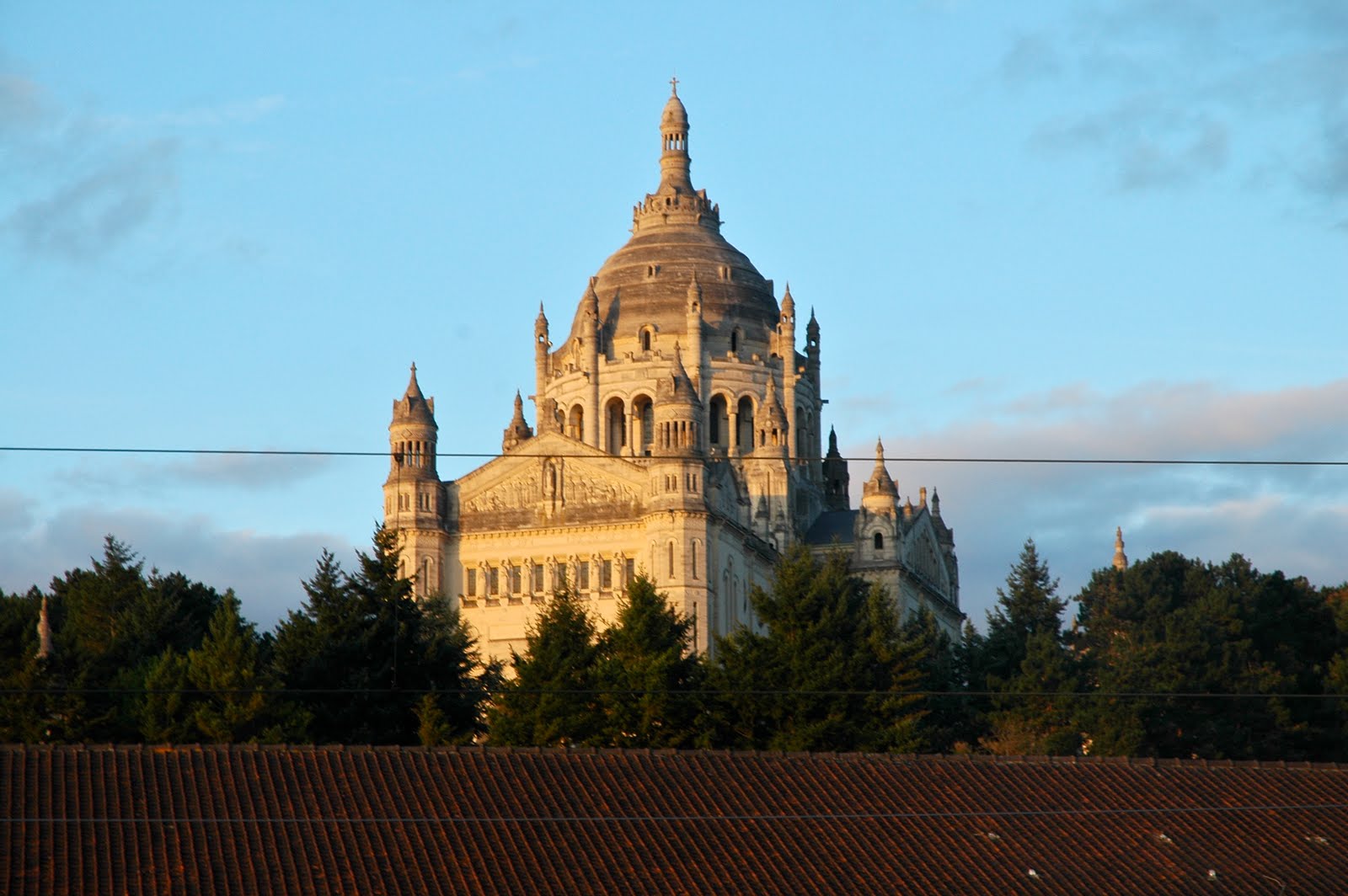
Even the stop in Liseux for a train transfer on the way home proved scenic; Tom took this shot of a hilltop basilica in the late evening sunlight.

Saturday, May 29, 2010

Apartment hunting horrories

If I had to guess, at this point I'd estimate that I've made about 50 calls pertaining to apartments, about 20 emails, and made about 15 visits. We're getting closer to finding the diamond in the rough, it seems, but the process hasn't been without its share of horror stories (horrories!). Sometimes you can tell in an ad that an apartment is going to be a dud. Take, for example, this real life (translated) ad: "Furnished studio apartment, seventh floor with elevator, well laid out, hot water, kitchenette, no shower. Available immediately."

No shower?!? You know it's a pretty pathetic apartment when the landlord is advertising "hot water" as one of its main selling points. Other automatic deal breakers include bathrooms in the hall (meaning shared with other tenants), basement (no windows) apartments, or the bargain apartments known affectionately as "studettes"--ancient maid's quarters converted into closet-like student residences for the poor and desperate. However, sometimes it takes a visit to discover the dark side of an apartment. Here are a few such experiences.

I spent an hour waiting at the first apartment I ever visited, waiting and trying in vain to call a landlord who never showed. I got in touch with her a few days later, only to discover that I had been waiting outside the wrong apartment. An elderly woman, she had given Tom the wrong number on the phone when he had scheduled the visit. Whoops.

The first apartment Tom and I visited together was in a good location and of a good size, but it needed a little TLC. The aged wood floor had deteriorated in a few places, leaving some noticeable impressions in the living room floor. The lights--lone bulbs hanging on cords from the ceiling--were burnt out and a little bare. The toilet had no seat. Minor fixes, we thought, until we asked when the work on the apartment was to be finished. We were told that no, the apartment was being sold as is, and not even by the landlord, but by the twenty-something cell phoning fiend he had selected to sell it on his behalf.

One apartment I visited was everything we were looking for price, space and furnishings-wise. Unfortunately, the would-be landlord there had been sort of illegally squatting himself for about 10 years. Turns out the apartment was some sort of subsidized housing that was legally rented by his sister, but that he had been using as a home base for his Internet-based, English-language advertising company (he never spoke a word of English with me, however). He was ready to move on to a new city but wanted to keep the apartment for his return in a few years and rake in rent in the meantime--"à l'Américaine", as he put it, which to him meant without demanding the same ridiculous amount of paperwork from us, but without providing us with a contract (and thus depriving us of the CAF, the student housing discount, and offering no guarantee of our status as tenants or of the safe return of our deposit). He was aggressive enough to intimidate me into saying I'd think it over, but I didn't give him my contact information, and as soon as I was back out on the street (free!) I got the hell away from there.

One apartment we visited turned out to be about a fifteen walk beyond the Boulevard Péripherique, and thus no longer even in Paris, but in Montrouge. However, since the size (72m2) seemed amazing for the price, we decided to check it out anyways. The landlord met us groggily at the door on Saturday morning, obviously hungover and still wearing his rumpled suit from the previous workday. Once upstairs, he instructed us to show ourselves around and then out, and to call him later. He wasn't kidding--a simple question evoked a wince and hand clasped to his forehead, along with a "no questions! Call later!" Needless to say, we didn't.

When apartments in Paris seem to cheap to be true, they are. One such apartment turned out to be a pretty ghetto residence, with a bed on stilts, a dilapidated wardrobe that didn't quite cover a molding wall and a bathtub that obviously hadn't been white in years. To top it off, it was being shown by its current tenants--two poor immigrants sharing a bed who were, themselves, grumpy with the state of the apartment and disparaging of the landlord's neglect. We crossed that one off the list.

Finally, there was the apartment I visited today. It, too, was in need of a little TLC (moldy fridge, dirty floor tiles, gross shaggy gray carpet), and the thing that really got to me was that the toilet room is so small that it's impossible to fully open the door without hitting the toilet. However, the price is good considering the size, so we're keeping it on the list for now. The good news: for once, the bohemian landlord is very pro-American and seems eager to have us as tenants. In any case, she said we were much better than the next woman she was showing the apartment to: a Chinoise! (Chinese woman!) et avec les animals! Pas ma tasse de thé... (and with animals! not my cup of tea...)

Thursday, May 27, 2010

Strike!

With the RER on strike (yet again) today, I opted to walk home from Denfert Rochereau. I started hearing Michael Jackson about half way along Rue Daguerre. I decided to investigate, and this is what I found:


Not far away, I ran into an awkward white dance party, rocking out to tracks from Grease:
(that's for you, Laura)


Block party? Festival? No, of course not. It's a strike!

Confused? So was I. It took a group of excited, costumed French workers and a few sheets of propaganda to explain it to me. Apparently the strikes are nationwide, against a new proposed law that would push the age of retirement back from where it is currently set at 60 years old. Their posters made me laugh: "6o isn't early enough, 40 years of working is already too much!"--not because I disagree with the idea, necessarily, but because starting work at 20 is pretty old by American standards, not to mention totally unrepresentative of French youth, who seem to linger around the house and mooch off their parents until their mid 20's.

Sticker of plebeian rage were everywhere:
As were banners and huge helium balloons strapped to cars:


There were a range of different career fields represented at the strike, from street cleaners, to industrial chemical workers, to nurses. This nurse was wearing a lab coat and a jester hat with syringes dangling from its points: Grève-ing starts young. Here, we see that even the students are invested in the age of retirement:
The magic words, it seemed, were "salariés respectés" (respected workers). For the French, retirement seems to be not so much a matter of resources (or lack thereof) so much as it is an issue of respect--or at least that's the way it is being framed in the reactionary rhetoric.
The parade started to move, and I moved with it, cheering and drinking in the excited atmosphere:
Many of the vans were equipped with loudspeakers and blasted music, motivational, anti-Sarkozy speeches or, most commonly, simple chants: (in this one, she's leading the paraders in a cry of "tous ensemble, tous ensemble--Grève! Grève!" or "all together, all together--Strike! Strike!" which is catchy, I suppose, if rather uninspired)


The MJ performance wasn't the only aspect of the strike that felt bizarrely party-like, as the drink menu on the ubiquitous food vans showed:
Ah. The abandoned, lime-filled cups and jolly strikers suddenly made sense.

This particular food van made me smile, because it seemed like the majority of its protest signage was general, revolutionary stuff (note the Che Guevera flag), which I assume means that it has been adapted for frequent use at this type of event. And you know what? That's probably a smart business move, because even if the economy plummets, France will still continue to strike (probably moreso) and those strikers will still want their 2 euro beers and baguette sandwiches. Even the French term "en grève" (on a strike) sounds to me like a habitual action, almost happy: "on vacation", or even comical: "gone fishing".
But maybe that's just because I've grown accustomed to hearing it with a casual attitude and a frequency that I never hear associated with its English equivalent. The French are often mocked for their eagerness to strike, but the American taboo on strikes reflects a cold, capitalist approach that values efficiency over workers' rights, and leaves the overworked and mistreated with little recourse. Striking in France makes these workers more visible, and as a result, more respected and more accommodated.

And even if the strike doesn't accomplish anything--if Sarko insists on dragging his 35-hr work week, early retiring country kicking and screaming into the modern world--well, at least the French got a good party out of it.

Friday, March 5, 2010

Goin to the salon to get my tastebuds did

At one point last semester, my grammar teacher launched into an unprovoked rant about how Americans are too out of touch with the means of food production and don't have enough respect for their farmers and other small family businesses. In contrast, she held that (and my commentary is in parentheses) the French are much more aware and appreciative of their farmers (in a distant, idyllically reverent way that no longer quite reflects the growing industrialization of the market...they're turning more and more to frozen and processed foods) and their animals and produce (less pesticides, more markets, fresher and more organic products, yes--but they still do quite a bit of international produce importing and you can't tell me that force feeding a duck to make foie gras out of its liver is much kinder than cooping up chickens). She also said that the French have a greater appreciation for regional products, even if they might be more expensive than the big box brand. This last one, at least, is very true. As is evidenced by the "appellation d'origine contrôlée" seal (which is the reason why America produces sparkling white wine instead of Champagne and blue cheese instead of Roquefort) the French are very cognizant and fiercely protective of their regional products. Our teacher's proof for her claims was the French love of the annual "Salon d'Agriculture", which is essentially a classier version of a state fair that's been drawing huge hoards of Parisians (and an obligatory appearance from the President) for the last fifty years.

That was several months ago. Now it's "salon" time, so a few other curious students from that class and I got up early (at our professor's urging...it gets crowded) to check out what France's agricultural realm had to offer. Like an American fair there was a livestock area and a produce area, where prize specimens were displayed, urban children had their first petting-zoo style contact with the natural world, and demonstrations were given. However, I popped my head in these pavilions only long enough to rediscover the clothes-satiating smell of rotting hay and animal sweat before I headed on over to the gastronomie pavilion. And Oh. My. God. I was in foodie heaven.

The massive, two-floored pavilion reminded me of Disney's Epcot, except that instead of representing different countries' cuisines, this represented different regions of France (and, limitedly, its overseas "departments"). Having paid our 6 euro entry, we wandered from booth to booth for endless tastings: ciders, apple liquors and soft cheeses from Normandy; red wines from Côtes de Rhone and Bordeaux; lavenders, perfumes, honeys and rosé from Provence (which made me super nostalgic for Nice); dry whites and sharper cheeses from the Loire; sweet whites, cured meats and champagne jelly from Alsace; apples and mushrooms from Île-de-France; mustard and melted cheese creations from Bourgogne; and bread and foie-gras from, well, pretty much everywhere. There was a really heavy emphasis on region, with booths grouped together geographically and many sporting maps with highlighted areas that were always indicated by the salespeople. The best part was talking to these salespeople, who were genuinely proud of their products and could describe the production process and subtleties in the taste in great detail. They were also, for the most part, very willing to educate and feed you even if you didn't seem interested in buying--meaning I got the chance to try some expensive wines and foie-gras that I wouldn't have otherwise.

I left around 2pm, just as it was starting to transition into weekend crowds (my professor wasn't kidding: the French love this place). My wallet was significantly lighter, but my bags were rich with treasure: aged chevre, a bottle of pear cider, some gourmet chocolate, groseilles (red current) jam, a saucisson sec (salami, sort of) and a Corsican sausage sandwich. Miam miam! (yum yum!)

Wednesday, March 3, 2010

Putting the "femme" in feminist

I got my first dose of French sexism during my semester in Nice in 2008. Our grammar teacher, a spry, elfish old man for whom I had a lot of respect, had a habit of asking questions that required a very specific answer. If we couldn't produce the exact answer he was seeking, he would often refuse to move on in the lesson until we did. There was one instance of this, when, after several minutes of our tentative guesses and mounting frustration, my friend Matthew (the only boy in the class) finally happened upon the right answer.

"YES! Finally. It's a good thing we have a man in the class to help out all of these empty-headed girls!"

The remark, accompanied by an eye-roll towards us and an esoteric wink of fraternity to Matthew, was delivered without a second thought. Even when I shot him a laser glare of feminist rage, he didn't pick up on the fact that what he had said was at all inappropriate. Because it wasn't, by France's standards. Although it's not always so overt, I've been encountering the same phenomenon this semester. My nineteenth century professor, who seemed to like the four of us women last semester, now acts differently with a guy in the class; there was an instant "chumminess" between them, and he continues to hold a sort of teacher's pet position in class discussion. In the section of my class at Paris III that is taught by a man, the French girls tend to adopt a Minnie Mouse voice, bow their heads and bat their eyelashes when speaking during class, as if they have been culturally conditioned to be coy when interacting with men.

Subtle opportunities for sexism continue beyond education. French CVs demand a photograph and often a relationship status, and after speaking with a few French women it seems to be generally understood that while not required, wearing a sexy skirt and boots will never hurt you in a job interview (regardless of the position). The scary thing is that, while they are quick to accuse African/Arab immigrants of being inherently sexist, the French are slow to recognize its signs within their own culture. My Paris III teacher brought up "la condition feminine" in reference to 18th century literature, only to conclude that "mais evidement, ce n'est pas notre querelle" ("but clearly, this has nothing to do with us"). Similarly, my female literary tutor challenged the idea of studying "the figure of the woman" as unnecessary and reverse-sexist in a modern-day context (although she was eventually won over when we pointed out how dominant studies of male characters are, it's just not as obvious because they're rich and dynamic and not reduced to a spokesperson for their gender).

All of this seems to stem from the fact that the French shun the American notion of the politically correct. While I'll be the first to admit that Americans can get a little too sensitive at times, the upshot to being easily bristled is that we have methods of recourse built into the system--we have noticeable attempts at the primary school level to educate children about tolerance, and clearly defined standards and processes to deal with things like sexual harassment. France, on the other hand, tends to operate under a "meh, don't take things so seriously, ladies!" method of operation, and then end up with anti-tobacco ads like the ones below, that make light of sexual abuse through suggestive imagery and the caption: "to smoke is to be Tobacco's slave"

I get it. Eye-catching. But seriously?

As it turns out, domestic violence and sexual abuse are HUGE problems in France right now, at least when compared to other Western nations. 160 French women are killed every year by violent boyfriends or husbands, accounting for more than half of the female homicide cases nationally. Due partially to the activism of NGOs like SOS Femmes and Ni Putes, Ni Soumises ("neither whores, nor submissive"), the notoriety of the statistics has gotten to the point where the government has finally had to start paying attention. However, while tracking bracelets and attention to the psychological toll of abuse are steps in the right direction, there's a cultural mindset that needs changing, and a generation of French women that need to put their fashionably-booted and heeled feet down. After all, it was largely French feminist activists/writers that inspired American feminism, so there has to be some woman power left lurking here somewhere...