Showing posts with label books. Show all posts

Thursday, August 26, 2010

Mastery and mille mercis

Tomorrow is the day that I have been both dreading and busting my butt for : my Master's exam.

Yup. In six hours and who-knows-how-many essays, I will have to prove to the grading committee that I have a Master's mastery of more than eight centuries' worth of authors and their works, and the literary/cultural/historical context that shaped them.

The intensive review process this month has been both stressful and rewarding, and has made me realize how much better my speed-reading and my written French have become this year, and how much I now know. On the right, I have reposted the picture I showed at the beginning of this year, of the Master's book shelf (although, once again, I point out that there are a few doubles mixed into the collection). Guess what? I READ THESE.

I'm not really sure who follows this blog anymore, but just in case, I would like to offer a preemptive thank you to all of my St. Mary's and CMRS lit professors, who I think did more to prepare me for the critical thinking/analysis parts of this exam than any of my "read! read more!" coaches at NYU. As part of my review process, I made myself a 150-page study guide of notes pertaining to context and significance of the works, and for source material I relied heavily on seemingly-ancient hand-written notes from classes I took with some of the brainiest women I know: Gantz, Doggett, Adams, and Wooley. Despite what the popular (and trite) saying suggests, I did NOT learn everything I needed to know in kindergarten; however, I just might have learned everything I needed to know in my college survey courses.

"Merde!"

As I left work yesterday, my last day of work before my Master's exam, I was treated to a heartfelt cries of "merde!" by all of my co-workers. When it comes to luck, the French are as superstitious as theater people, so the only words of encouragement they permit themselves is this (rather vulgar but amusing) variation on the "break a leg" idea. (My supervisor, however, followed her exclamation with a look of fear--"you do know that we say that right? Ok, good. I just realized how confusing that could be to a foreigner...") So in the spirit of Merde...

During my reviewing this month, I have permitted myself brief pilgrimages to the burial sites/monuments of some of the writers whose work I admire. I saved the photos for now, to offer as a last-minute tribute to their ghosts, who I hope will provide me with inspiration (not to mention hand endurance and cramp resistance!) in my furious writings tomorrow.

In the Latin Quarter's Saint-Etienne du Mont church, in the shadow of the Pantheon, I found Racine:
And Pascal:
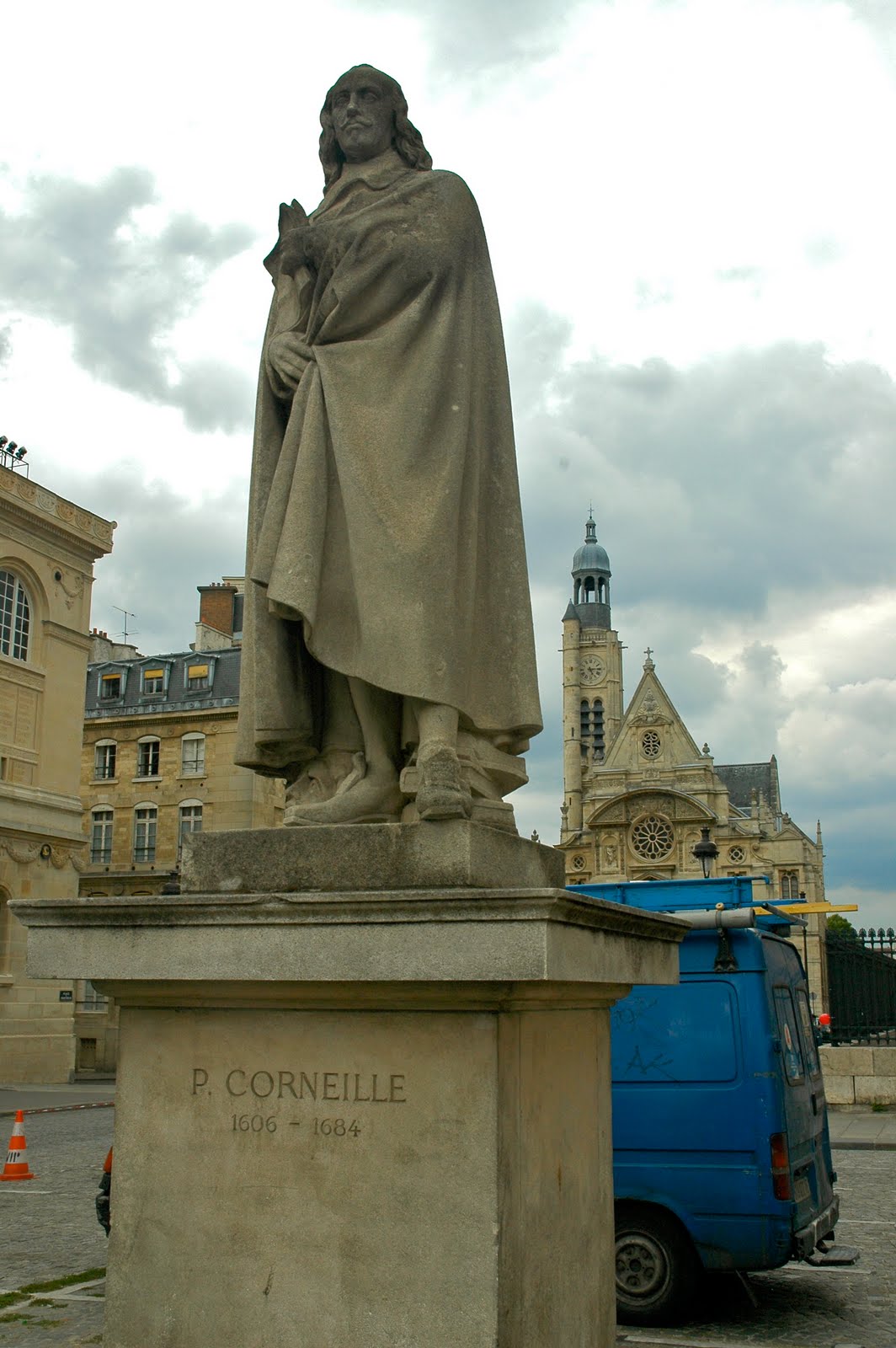
And outside the same church, their compatriot Corneille:
Diderot, beneath the Pantheon's dome:
In the Pantheon's catacombs, Victor Hugo and Alexander Dumas on the left, and Emile Zola on the right:
Also in the catacombs: Rousseau...
...and Voltaire:
The entrance to the Pantheon's catacombs bears an inscription in honor of the "writers who died for France"
Flaubert, in his family vacation spot of Trouville:
Moving on now to the Montparnasse cemetary, the shared grave of kindred spirits and love and philosophy, Sartre and De Beauvoir:
Close up of their grave, bearing Oscar Wilde-like kisses:
And of the metro ticket and centime tributes left by visitors:
Marguerite Duras:
Baudelaire (who, unfortunately, was forced to share a tomb with a stepfather he hated):
Beaudelaire's tributes:
My favorite absurdist, Eugene Ionesco:
And his anglophone contemporary, Beckett:
And, last but not least, Guy de Maupassant...
...and a hand-written note of appreciation, shoved into a crevice in the stone:

Friday, May 28, 2010

The "romantic" life

On Wednesday, I had a museum date with a girlfriend to go see the Chopin exhibit at the Musée de la Vie Romantique, or the museum of "romantic life." Despite the images that the name might evoke (not to mention the nearby Pigalle area, host to the infamous Moulin Rouge burlesque shows, sex shops and the Musée de l'Érotisme) the museum has nothing to do with romance, but rather focuses on Parisian life during the romantic movement in art. Indeed, stepping off of the bustling, business-filled streets of Montmartre and into the alley of the museum felt like stepping back in time. As I walked into the green courtyard, it was easy to imagine the days when its ivy-covered cottages still housed the studios and salons where musicians, authors, opera divas and aristocrats shared inspiration over coffee.
As a pianist currently learning/studying Chopin, my friend Clare was primarily interested in the musician and the artifacts surrounding him, including a plaster cast of his slender hand and an antique piano he played on. I was more interested in his longtime lover, George Sand, one of France's first "feminist" (not to mention just female) writers who I gave a presentation on earlier this semester. The exhibit was riddled with portraits and quotes of her and her children, who both played into the 19th century Parisian social scene (not to mention the sudden, violent end of George's affair with Frédéric, which is presumed to have involved her daughter Solange). I couldn't get a photo of the iconic portrait of her they had on display, but here's a copy (thanks, Internet!):
After we had our fill of art, we enjoyed some tea and cake in the garden café.
I loved the cute (if not slightly racist--oh the French!) mitten for the hot metal handle of the théière (teapot), complete with Turkish tasseled fez:
The on and off spring showers kept the crowds away, but we were definitely not the only people out enjoying the resulting flowers.

Thursday, April 22, 2010

Hyde and seek with French littérature

Knowing I needed to get some reading done in London but reluctant to miss out on playing tourist, I compromised with a leisurely morning in Hyde Park and its neighboring Kensington gardens. After roaming the grounds, I bought a latté at a lakeside café and dove into Maupassant (a 19th century book I really enjoyed, about a man from humble origins who takes advantage of the fact that he has an irrisistable moustache--seriously!--to seduce numerous rich/powerful women).

The park itself was nice; a little less manicured than Parisian parks and but still full of fountains and memorials, and even memorial fountains! My favorite find was a Peter Pan statue that was apparently commissioned by J. M. Barrie and installed in the middle of the night to appear as if by magic for children in the morning.


Later in the day I wandered through some posh neighborhoods and past a pub frequented by Voltaire (I suppose during his post-Candide exile?) over to the Victoria and Albert Museum. Like D.C.'s Smithsonian, all London museums are free, so I went on in and began browsing their collections of British artifacts. The museum itself was pretty interesting, housed in a building that mixed the old and the new, with a traditional dome in the lobby paired with a strange modern glass sculpture. Its open, two-story wings allowed you to look down onto the exhibition floors of castings from above, which was a cool perspective. The museum's contents were a strange mix as well, ranging from European antiques and artwork to less traditional museum fare like ironworks, early digital art, and even a wing celebrating theater via a collection of costumes, props and lighting. The definite highlight was the impressively lifelike rhino costume (but is it an Asiatic or and African?) used in Ionesco's Rhinocéros, which has remained my favorite absurd theatre piece since I read it for a course a few years ago. Brilliant.


Tuesday, March 30, 2010

Bumming around Brittany

A trip to Bretagne (or Brittany, for you anglophones) has been at the top of my French "to visit" list for several years now, and thanks to trustfundergrad tuition I was finally able to make my pilgrimage to the land of crêpes, cider and cobblestones. Our first stop was Didan, a picturesque but otherwise unremarkable town known for its crêpes. I had a savory sausage and potato crêpe, followed by marzipan and salted caramel à la mode crêpes for dessert.

The next stop was St. Malo, a tidal beach town encircled by a medieval wall. A popular tourist destination during the summer (especially for British tourists, who can take a ferry across the English Channel), it's apparently not so balmy in March, giving us a chance to experience Bretagne's infamous and incessant wind and incessant rain. We shivered as we followed our great local tour guide aro und the rocky coastline, envying her outfit that wouldn't stand up to Parisian fashion standards but was definitely more practical: a windbreaker, a warm winter hat and rain boots.

The coolest thing about St. Malo is the fact that its waters are extremely tidal, meaning that huge stretches of beach and even a salt-water pool magically appear at low tide (the pool's diving board is still visible above the waves at high tide, to rather comical effect). Low tide also reveals a "path" (sandy ridge) leading to the tomb of writer Chateaubriand, who was a town native and fought for the right to be buried on a small island just offshore. Although I'm not a huge fan of Chateaubriand's work it was cool to once again witness the appreciation the French have for their literary legacies, which was also evident at the Hôtel Chateaubriand that we stayed at, located right next to the shrine-like site marking the writer's former house.

We also found a cute, childhood-themed bar, whose walls were adorned with dolls and old games and whose barflies sat not on stools but on swings! I was in love with the ambiance and the non-Parisian prices, although I was a little sad that we couldn't stay late enough to find out what happens when drunkenness and swings come together.

The next day put us just over the provincial border into Normandy for a hayride-esque romp through the tidal swamps with a few local fisherman. A tidal trap and seining net allowed us to examine some of the local sealife (see the skate pictured here), and the fresh sea air satiated my recent nostalgic longing for the Chesapeake Bay. Accompanied by a bunch of land-lubber NY-ers, I also realized how much practical aquatic knowledge I acquired as a result of my years camping with my family and studying at St. Mary's. I quickly found myself explaining how crabs breathe and how to pop off a shrimp's head and tail and the difference between flounders and dorade to a bunch of clueless underclassmen.

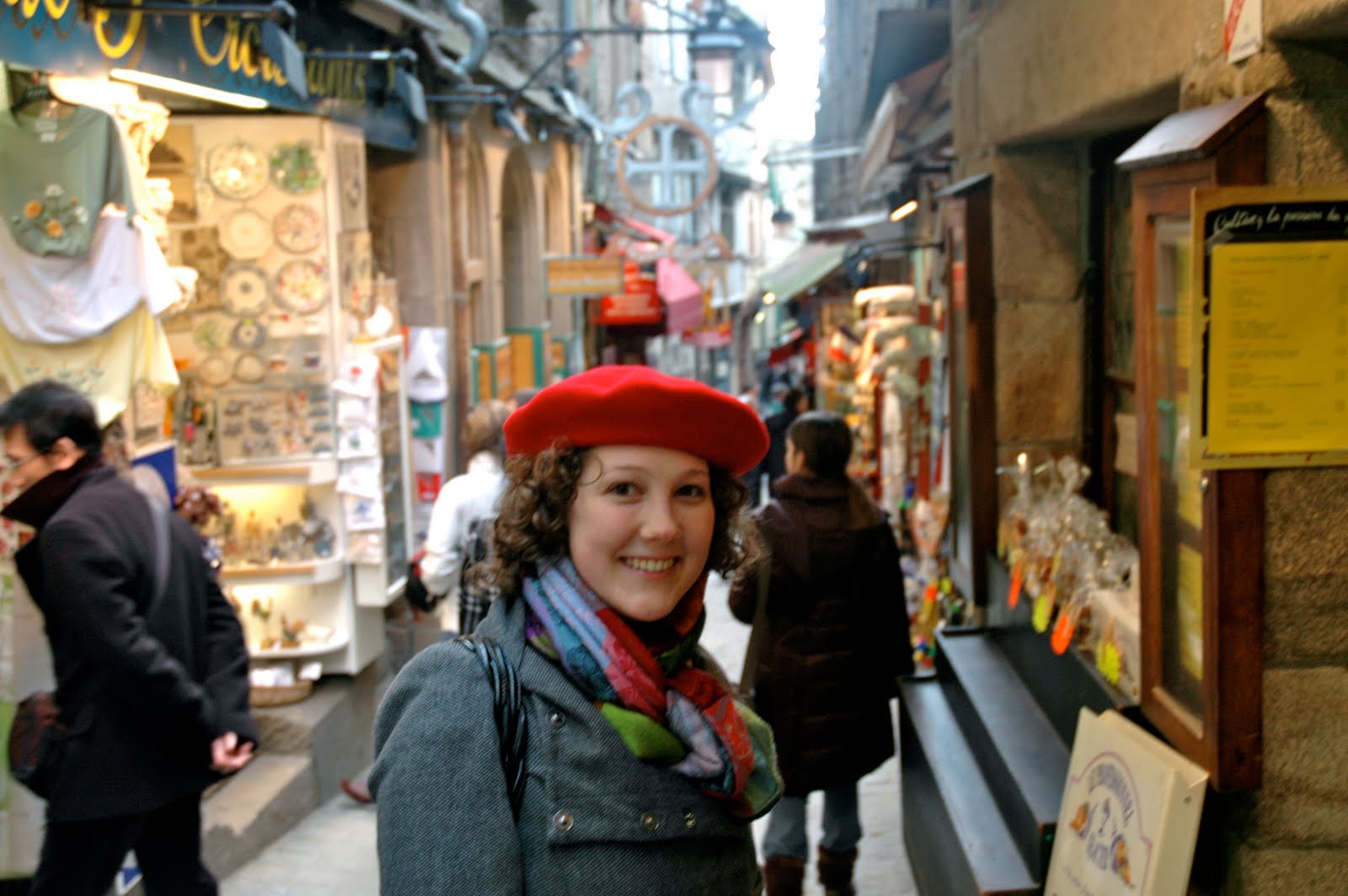
Our last stop on the tour was Mont St. Michel--a beautiful fortified island topped by an impressive abbey and cathedrale. This also gave me a chance to witness the Brittany/Normandy rivalry (ownership of the Mont has been and still is contested) as well as their fierce regional pride...natives of both places referred to their provinces and France as if the two were separate entities, as in fact they were in fairly recent history. (Both, however, are united in their scorn for the British, who were historically the reason for such intense stone fortification.) The Mont was pretty amazing, although more touristed than I had expected--apparently it's the top tourist destination in France after Paris. We wandered through steep and narrow shop-lined streets, enjoyed a shellfishy lunch, and toured the religious sites at the top, leaving in time to reach the mainland before the meter per second tide came rolling back in to cover the road and once again cut off the island.

Thursday, March 25, 2010

Esoteric Intellectualism

The class taught by aging Algerian writer Assia Djebar that I had last semester has been replaced this semester with a course by another writer/professor, X. X is more on the ball than Djebar was, although I've had an unusually hard time getting a feel for X as a teacher, much less as a person.

Like one of my other professors, X is a graduate of École Normale Supérieure (ENS), one of the "Grandes Écoles", which is about the closest France comes to having "Ivy League" schools. However, there is a definite difference between the two. While financial/educational resources or a lack thereof definitely keep the Ivies pretty WASPy, there's a general understanding that if a student has competitive enough test scores, GPA and drive, she can get accepted at an Ivy. This is particularly true for graduate school when undergraduate performance and full fellowships tend to even the playing field a bit. In France, however, you're groomed to go to a Grande École from a young age and generally only if your social status fits the mold. Another difference is public perception of the degree. In the States, a degree from Harvard Law or Yale is somewhat of a prerequisite for the rich and powerful--you need the degree to give you a credible base upon which to build the platform of opinions and experience that will earn you respect. In France, the degree itself commands respect and IS the power/wealth--it represents an instant "in" for pretty much any career. Case in point: the French are fairly blasé about the fact that I'm dating an English physicist until they hear that he's a student at the prestigious "École Polytechnique": "ooooh! C'est pas mal, ça." Similarly, each time one of us students questions the pedagogy of one of our ENS professors our concerns are immediately dismissed by the French NYU administrators: "well, he DID study and work at ENS...he must, of course, be right." To an Américaine it seems to be a small detail, but it's one that completely changes the direction of the conversation.

X's apparent genius as an ENS professor is enhanced by X's literary career, which I have to admit is pretty impressive (it includes several collections of poetry and a handful of novels, one of which won the prix Goncourt for first novel). I've now been to two extra-curricular presentations of X's newest novel which have been enlightening in terms of the mix of well-educated attendees and the panel of intellectuals (poets, artists, writers) that served as discussion leaders/moderators. It's cool to see that the novel-as-art is still valued in an age of cheap pulp fictions, and also that the centuries-old insular community of French intellectuals surrounding it is still intact.

And then there's X as a teacher. I'll give X this: X is a smart cookie. X speaks several languages, lapsing easily into English to find the idiom that better fits the situation (albeit in smug sort of way). X also, like me, is prone to make connections between our French texts and other works, especially English literature and old black-and-white movies (although I can rarely relate to the esoteric allusions X makes). With a paper due every week to be read aloud and picked apart in front of the class, the class pushes me to read more critically and write well, even as it terrifies me. And as was the case with Djebar, it's interesting to see how X's role as a writer influences X's author-centric approach to a text: X focuses on small passages to highlight style, word choice, voice, etc. and has us do the same in our "commentaire composée" assignments, making X's class seem almost like a creative writing workshop at times.

However, like Professor Slughorn from Harry Potter, there's something slightly guarded about X, and X's almost bipolar--swinging from an energetic high one week to a vengeful, scornful low the next in a pattern that I'm beginning to think correlates with the success X had (or didn't have) writing that morning. Like Slughorn, X's also interested in the "high flyer" students and creating X's own manner of elite slugclub. During the first few weeks of class X would hold us back two at a time to grill us about our ambition while obviously sizing us up, determining if we were worth interest. Those who aren't are overlooked during class, while those who might be have their essays picked apart more viciously.

I was running in Parc Montsouris a few weeks ago when I saw X, positioned in front of a forested backdrop and looking poetically into the distance as a camera crew went to work. I stopped, of course, and waited for the camera to stop rolling to approach. Out of context it took X a minute to place me, and once X did X was completely disinterested. "What are you doing here?" X demanded, as if I had followed. "Running," I replied, thinking "duh" as I indicated my clothes, my iPod, my red face. "I live right there." Eyes still angry, X suddenly broke into a wide smile, telling the camera crew that I was one of X's students and explaining that the arts channel was doing a special. "Well, see you next week!" X said.

I can tell when I'm not wanted. I put my ear buds back in, waved, then proceeded to take another route for the remainder of my run. I can't deny that I'm benefiting academically from X's genius, but I'll limit my X quality time to class time. I'm hard enough on myself without being made to feel like a Weasley.
Tuesday, March 2, 2010

Paying homage

I took advantage of the break in stormy weather last weekend to stroll around Père Lachaise cemetery. It wasn't quite sunny (of course), but the gloomy, overcast lighting (and the creepy cawing crows in the skeletal trees) really helped to set an appropriate mood.

Let me start off by saying that I don't have a newfound obsession with death, or anything of the sort--no, Paris hasn't made me emo. A visit to this cemetery has been on my to-do list ever since my arrival, and I've been reminded of this by the fact that it features fairly prominently (*cough Balzac cough*) in the the 19th century literature I've been reading recently. Established by Napoleon in 1804 outside of Paris as an alternative to other, already over-crowded Parisian cemeteries, it was shunned by the French until the remains of beloved writers and intellectuals La Fontaine and Molière were un-earthed and reburied within its grounds. Since then, anybody who is anybody has scrambled to have their loved ones interred alongside these heros. Today the once peripheral cemetery has been engulfed by the Belleville neighborhood (you can just see the distant spike of the Eiffel tower behind the Gothic spire in the photo to the left), and the French and tourists alike pilgrimage to visit its World War I memorials and tombs of countless notable Frenchmen (and women).

I came to visit the tombs of Oscar Wilde, Colette, and Balzac. I'm sure you all know of Oscar Wilde, but here's a brief history of Colette: married to a man who took credit for her first novels. Divorced him to become a burlesque actress and a fairly hi-profile bisexual, eventually remarrying only to have an affair with her teenage step son. Wrote very sensual books with theatrical tendencies and strong female leads. Overall, a kind of wild and scandalous character, and her grave was surprisingly understated, considering. It was better kept and had more tributes than any others I saw, though, which warmed my heart. The classy granite also gave it a much more modern look than the rest of the cemetery.

Oscar Wilde's grave was appropriately campy. An art deco creation with a sphinx-head, it has been adorned with the kisses and love notes of a thousand adoring groupies, whose oily lipstick and "je t'aime, Oscar!"s permanently stain the stone. They've added a plaque imploring visitors not to "deface" the grave, although I have to admit that if I were Oscar I know I'd appreciate the postmortem loving--especially considering that some of those kisses would be from gorgeous men.

Balzac's grave was pretty predictable: respectable but boring. The author of approximately a billion super-long novels (actually just a few under 100, but still pretty insane), Balzac is France's go-to literary hero. His grave featured a copper bust of his rather chubby, boyish face, but then a rather stylish book and plume at the base.


And to finish up, here are a few assorted shots I took: