Showing posts with label beyond Paris. Show all posts

Saturday, August 21, 2010

à la plage

In spite of my busy studying schedule, we decided last minute not to entirely forgo a vacation and spent a weekend in Trouville and Deauville, two sister beach towns on France's northern Côte Fleurie:
I loved Normandy's beach culture. It had this really humble, authentically French feeling. It was much less trashy than Nice became in the height of tourist season, and sophisticated in a less ritzy way than the smaller Côte d'Azur towns. This is Trouville's equivalent of a boardwalk--consisting of playgrounds and pony rides for children, gelatto and cocktails for their parents, and a plethora of cute sea-side cafés that were surprisingly cheap given their location. We went to a salad place for lunch (smoked samon for me; roquefort, ladons and norman apples for the boy) just to the right of where I took this photo.

Trouville is also where Flaubert (the author of Madame Bovary) used to take his holidays, so there were various tributes to him scattered around the town. The swan on the side of the hotel in this picture is actually bearing a sleeping Flaubert on its back--it's the "Hôtel Flaubert".
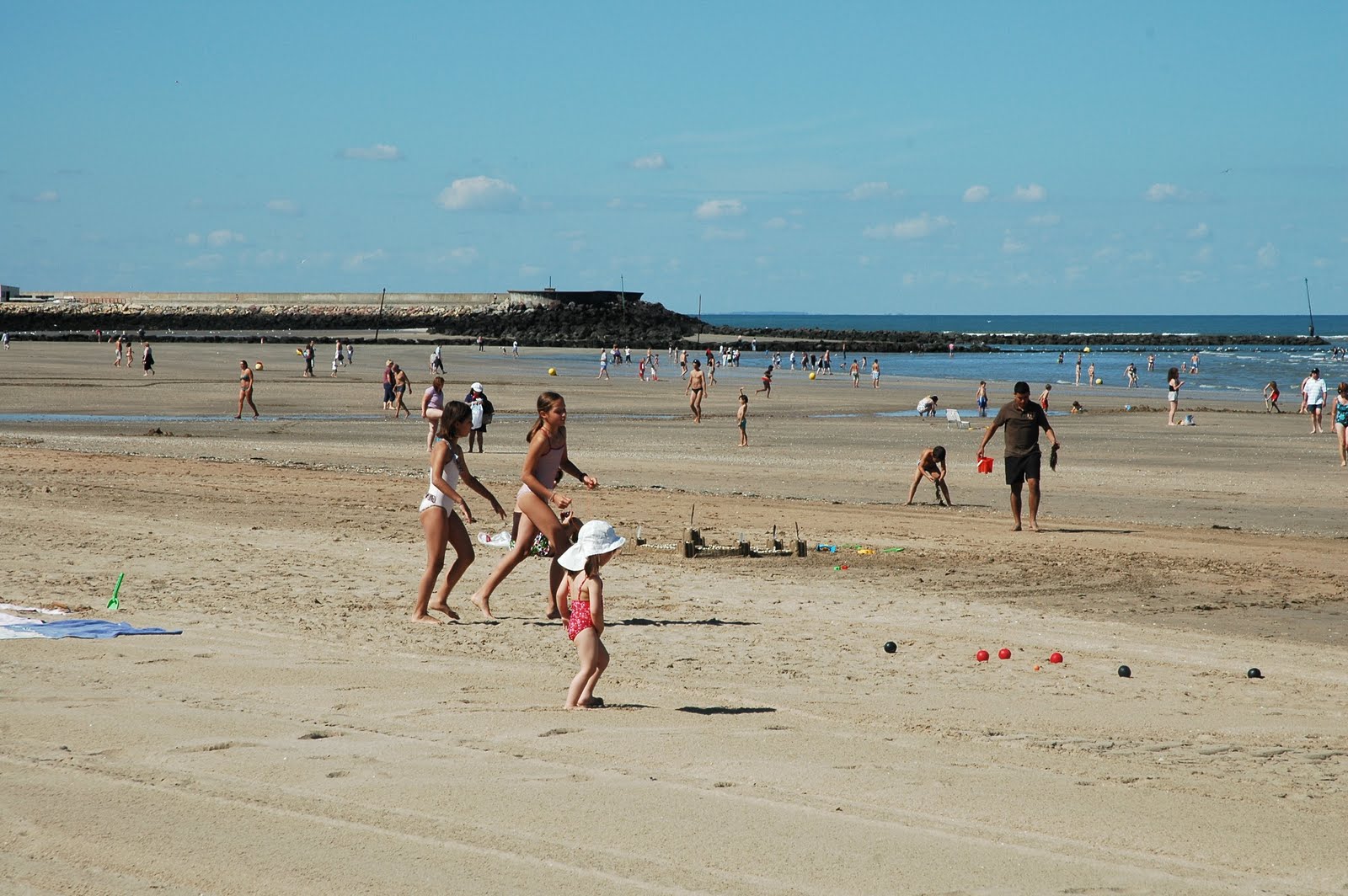
I was in love with this little girl and her huge floppy white hat. Here, she and her sisters are demonstrating one of the favorite French pastimes: pétanque (a ball-rolling lawn game, kind of like bocce ball). The beach had a special roped-off pétanque area (it's ideally played on dirt/sand that is packed down really firmly) and sets of the heavy metal balls to loan, but many families brought their own, plastic, beach-friendly versions.
Trouville town hall:
Trouville patisserie/chocolaterie. The decorative anchors and flower balls were the keystones of the town's picturesque landscaping efforts.
We managed to score a lovely hotel room with a last-minute discount.
The room even came with a sunny balcony, overlooking the center of town:
View of the pub, from the balcony:
And the night view, looking towards the strip of seafood restaurants. The restaurants' menus were virtually identical, but the hoards of French families on holiday didn't seem to mind. In fact, they seemed almost to expect it as a vacation rite: a bottle of white wine chilling in an ice bucket, an appetizer of terrine or smoked meats, an overflowing shellfish platter to share, or, of course, the French favorite: moules frites (mussels and fries). We opted for a fish dinner (with whelks as an appetizer...not sure how I feel about those). Ordering fish in France is always a bit of an adventure, because if the catch of the day varies from basic salmon or tuna I'm usually at a loss for the English translation. We had "julienne," which, looking it up now, is something called "sea burbot," a relative of cod. (It was delicious, in any case.)
We spent our second day in Deauville, separated from Trouville by a stream that empties into its exclusive harbors and boat clubs. Deauville is known as a haven for the rich, and it was evident from the moment we crossed the bridge and were met with polo, private yachts, and fancy homes and condos that were, rather oddly, built in a Strasbourg-esque, tudor style, and looked more like a winter ski home than a beach house to me:
The beach at Deauville was wider and more well-kept, but lacking the seaside cafe/bar culture of Trouville:
Little beach tents for overheated children to rest in seemed to be all the rage:
I don't see many children in Paris (or at least that don't fall into the category of either a) belonging to tourists, or b) the acting and dressing too-old-for-their-age inner-city teenagers) so it was kind of refreshing to see so many happy families and their very adorable, very French children:
Late afternoon shot of the Deauville beach, and its low tide wet sand. I've never seen so many hermit crabs in my life.
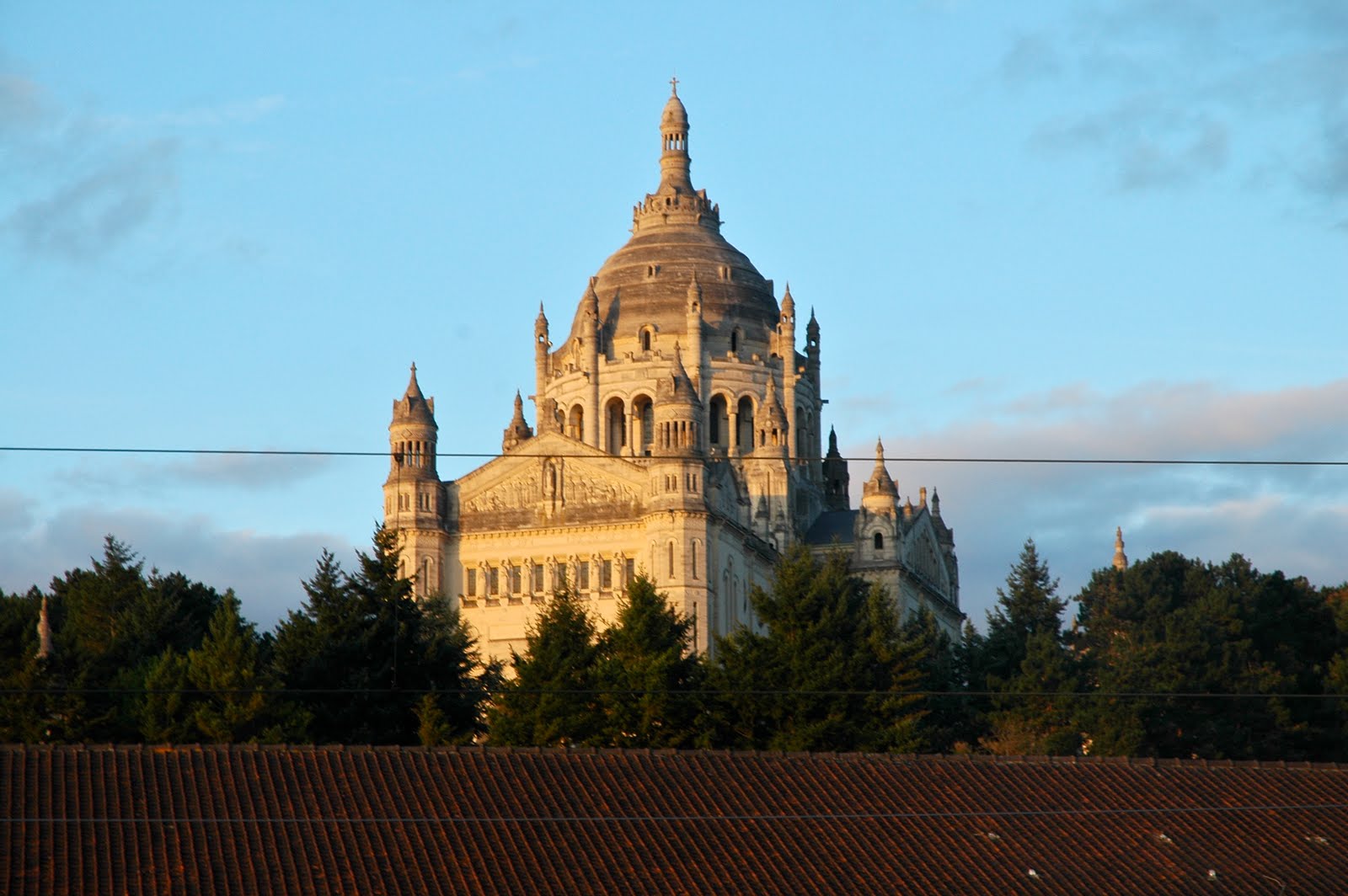
Even the stop in Liseux for a train transfer on the way home proved scenic; Tom took this shot of a hilltop basilica in the late evening sunlight.
Saturday, June 26, 2010

Giverny revisited

One of the perks of my new job is that I occasionally get to lead/accompany American undergraduates on their trips in and around Paris. Last Friday, for example, I got a free trip (and comp'ed lunch) to Giverny--the rural town to the Northwest of Paris that Monet once called home. Longtime readers of this blog will remember that I was here in the fall for my graduate orientation, when the apples were ripe and falling from the trees. This time around I got to see a little more of the flowers.

Odd flower:


See the bee?
Another bee, in flight this time:

By far my favorite shot of the day. Considering having it printed as a poster to fill some of our blank wall space:

Sunday, April 11, 2010

Nantes Jaunt

I spent this past weekend exploring another corner of Bretagne (Brittany). By "exploring" I actually mean "eating my way through", à la Eric Carle's very hungry caterpillar. This trip was organized by our French office assistant who has a taste for the gourmet, so we took full advantage of all of the fresh fish, kouing aman pasteries, salted caramel, crêpes and non-Parisian prices the region had to offer.

We started in Nantes, the capital of Bretagne and the 6th largest city in France, which was cute if rather bland. With a tram system, a small "ethnic" quarter, a medieval center and six-floor white buildings with wrought-iron balconies, it felt basically felt like a smaller, cleaner Paris with less people and wider streets. Highlights were visiting the little fortified castle in the town center, where you could see an old German war bunker from the WWII occupation as well as the site where the Edict of Nantes was signed. Before leaving Nantes we payed a visit to the Île des Machines exhibit, a "robotics" museum/workshop where one can see/interact with mechanical wood artwork vaguely inspired by the imaginary universe of Nantes-ian writer Jules Vernes. The coolest robot by far was an enormous wood and leather elephant, which is big enough to fit 40 passengers for a short jaunt around the square.

Next we hopped on a bus and continued on to a Muscadet vinyard on the edge of the Pays de la Loire Departement. The couple that owns and single-handedley runs the vineyard gave us a tour of the still rather dead-looking vines and the production facilities of their award-winning wine. I learned about wine production I hadn't known previously. Apparently you don't leave the grape skins in wine (too sour) and red grapes can therefore be used to make white, rosé or red wine depending on the delicacy and time-frame of the juicing process (for example, apparently all "authentic" Champagne comes from red grapes). Even if they don't do much for the taste, however, the skins are the source of the yeast, which ferments the wine by converting sugar into alcohol until such a point that it dies from the alcohol concentration it has created. (The difference between grape juice and wine is therefore simple pasteurization, which kills off the yeast before they get a chance to start making alcohol.) Afterward the wine-making lesson we were treated to a wine tasting of a young 2009 Muscadet (sweeter, almost bubbly, and more acidic) and an older 2003 one (drier, smoother). I liked both, but opted for the older as my souvenir.

We spent the night in La Baume, a small coastal town that was pretty, though pretty much like any Maryland or Delaware beach town in the off-season. The water was still a little cold for swimming but we enjoyed a stroll along the sand to find some shells, and our five course dinner was in a restaurant literally on the beach.
Saturday started with a trip to the marshes of the Presqu'il de Guérande, where the famous "fleur de sel" sea salt is harvested by hand from seawater channeled inland and concentrated in a series of canals and shallow pools. We toured the salt pools, then visited a co-op to purchase some local food products: jams from local berries, a seaweed tartar (also harvested from the swamps), Bretagne's famous salted caramels, and of course, salt. The salt looks like greyish rock salt and is valued by gourmet chefs for its delicate flavor. I'm not going to lie, I don't quite "get" it, but considering that a wholesale bag was only a euro I figured I'd give it a try.

A later boat ride through the swamps made me nostalgic for the Chesapeake Bay, whose shallow waters, grassy duck blinds, herons and crabs are surprisingly similar to those in Bretagne (although, of course, better--Maryland pride!). We ate lunch in the fortified medieval town of Guèrande, then walked around the picturesque village of Khérinet to see the rustic houses with roofs made of swamp grass. By the time I finally got back I was gorged with gourmet food, exhausted, and highly satisfied: both to have seen a little more of the "real" France beyond Paris and to have that feeling of returning "home" attached to Paris on the train ride back.

Saturday, April 3, 2010

Tourisister, day cinq

Nicole has spent the day dissecting basic French sentences and talking about taking French classes when she gets home. Her reasoning? Paris is the first city she really likes, and she thinks she could totally see herself living here if only she spoke the language.

I'm not sure if that's a win for me or for France, but I'll take the the credit either way.

Today we took the RER C train to the end of the line to admire the decadent luxury of the Versailles Chateau that was home to the last kings and queens of France. (Back story: fearful of pissed off Parisian peasants, the King decided to relocate his palace from central Paris, the building that currently houses the Louvre, to Versailles, a castle in the country where he was still close enough to the capital to be useful but far enough to fritter away tax money without being bothered by his citizens. Rather than fear hostility from the nobility, the king brought them along, too, gave them housing in his gilded castle and made them a part of the lavish ceremonies surrounding his personal life. Alas, all of this only served to delay the uprising, and the royal line was beheaded a short while later.) The chilly, rainy weather prevented us from wandering too far into the extensive gardens, although we did get a good view of the main fountain and hedge patterns from the windows in the upper floor. Nicole's favorite parts were the over=decorated bed chambers of Louis XIV and Maire Antoinette. Mine was the celebrated "Hall of Mirrors" which was fully restored and operational for the first time during my many visits--in fact, here's a picture!

We took a late afternoon coffee break at my favorite café to sample some macarons (a French delicacy cookie made of cream and meringue). Nicole loved them so much that she's determined to buy a small box before she leaves as her "souvenir" to eat on the plane. She also learned how to grocery shop à la française as we picked up ingredients for a make-your-own-pizza dinner and Saturday morning brunch. In other words she learned to use a small cart, weigh and price her own vegetables, bag her own groceries in environmentally-friendly reusable sacs, and only buy as much as can be comfortably carried home.

For an after-dinner treat, we headed out to Trocadero for the outlook over the Eiffel Tower and its reflecting pool, popping a bottle of "Champommy" (a sparkling cider with a champagne cork) as the tower sparkled at midnight. In the company of countless other young people who were celebrating with more than cider, she also got a lesson in flirtatious French men--luckily, she had me there to tell them to "va-t'en."

Tuesday, March 30, 2010

Bumming around Brittany

A trip to Bretagne (or Brittany, for you anglophones) has been at the top of my French "to visit" list for several years now, and thanks to trustfundergrad tuition I was finally able to make my pilgrimage to the land of crêpes, cider and cobblestones. Our first stop was Didan, a picturesque but otherwise unremarkable town known for its crêpes. I had a savory sausage and potato crêpe, followed by marzipan and salted caramel à la mode crêpes for dessert.

The next stop was St. Malo, a tidal beach town encircled by a medieval wall. A popular tourist destination during the summer (especially for British tourists, who can take a ferry across the English Channel), it's apparently not so balmy in March, giving us a chance to experience Bretagne's infamous and incessant wind and incessant rain. We shivered as we followed our great local tour guide aro und the rocky coastline, envying her outfit that wouldn't stand up to Parisian fashion standards but was definitely more practical: a windbreaker, a warm winter hat and rain boots.

The coolest thing about St. Malo is the fact that its waters are extremely tidal, meaning that huge stretches of beach and even a salt-water pool magically appear at low tide (the pool's diving board is still visible above the waves at high tide, to rather comical effect). Low tide also reveals a "path" (sandy ridge) leading to the tomb of writer Chateaubriand, who was a town native and fought for the right to be buried on a small island just offshore. Although I'm not a huge fan of Chateaubriand's work it was cool to once again witness the appreciation the French have for their literary legacies, which was also evident at the Hôtel Chateaubriand that we stayed at, located right next to the shrine-like site marking the writer's former house.

We also found a cute, childhood-themed bar, whose walls were adorned with dolls and old games and whose barflies sat not on stools but on swings! I was in love with the ambiance and the non-Parisian prices, although I was a little sad that we couldn't stay late enough to find out what happens when drunkenness and swings come together.

The next day put us just over the provincial border into Normandy for a hayride-esque romp through the tidal swamps with a few local fisherman. A tidal trap and seining net allowed us to examine some of the local sealife (see the skate pictured here), and the fresh sea air satiated my recent nostalgic longing for the Chesapeake Bay. Accompanied by a bunch of land-lubber NY-ers, I also realized how much practical aquatic knowledge I acquired as a result of my years camping with my family and studying at St. Mary's. I quickly found myself explaining how crabs breathe and how to pop off a shrimp's head and tail and the difference between flounders and dorade to a bunch of clueless underclassmen.

Our last stop on the tour was Mont St. Michel--a beautiful fortified island topped by an impressive abbey and cathedrale. This also gave me a chance to witness the Brittany/Normandy rivalry (ownership of the Mont has been and still is contested) as well as their fierce regional pride...natives of both places referred to their provinces and France as if the two were separate entities, as in fact they were in fairly recent history. (Both, however, are united in their scorn for the British, who were historically the reason for such intense stone fortification.) The Mont was pretty amazing, although more touristed than I had expected--apparently it's the top tourist destination in France after Paris. We wandered through steep and narrow shop-lined streets, enjoyed a shellfishy lunch, and toured the religious sites at the top, leaving in time to reach the mainland before the meter per second tide came rolling back in to cover the road and once again cut off the island.